
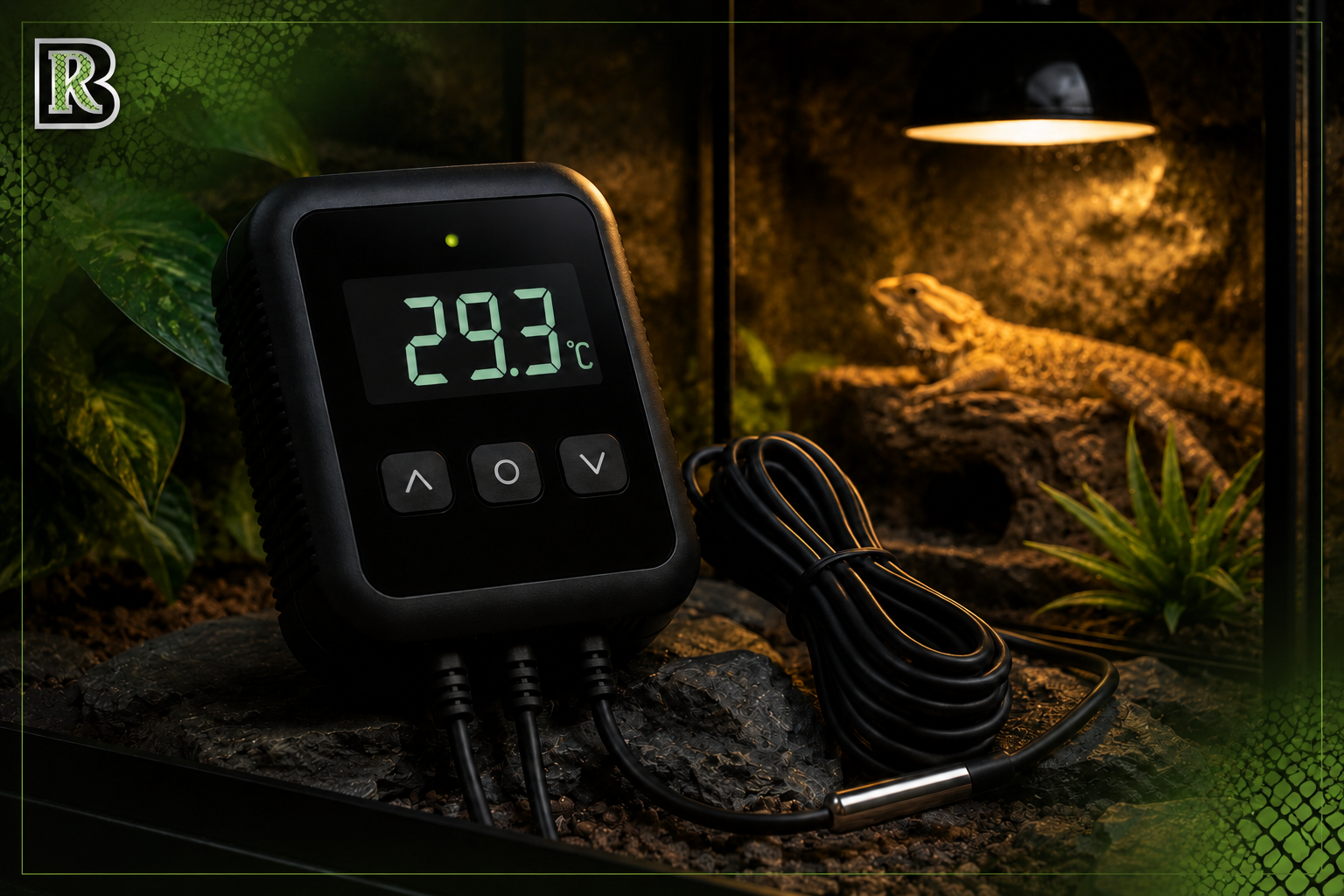
When it comes to keeping reptiles, temperature is everything. Unlike mammals, reptiles are ectothermic — meaning they rely entirely on their environment to regulate their body temperature. They cannot generate their own body heat internally. This makes your heating setup, and more importantly your thermostat, one of the most critical pieces of equipment in your entire enclosure.
Get the temperature wrong — even by a few degrees — and you risk serious consequences. Too cold and your reptile’s immune system weakens, digestion slows, and appetite disappears. Too hot and you risk fatal overheating in a matter of hours. A reliable thermostat sits between your heating element and your animal, acting as the guardian of that perfect thermal environment.
This guide breaks down everything you need to know about reptile thermostats — what they do, the different types available, and how to choose the right one for your specific setup and species.
What Does a Reptile Thermostat Actually Do?
A thermostat monitors the temperature inside your enclosure using a probe sensor and automatically switches your heating element on or off to maintain your target temperature. Without a thermostat, your heater runs continuously — which means temperatures can spike dangerously high, burning your animal or destroying your equipment.
Think of it this way: your heater produces heat, but your thermostat controls it. One without the other is either useless or dangerous.
The Three Main Types of Reptile Thermostats
1. On/Off Thermostats The simplest type. When the temperature drops below your set point, the heater switches on. When it reaches your target, it switches off. These work well with ceramic heat emitters and heat mats but are not suitable for basking bulbs — the constant switching shortens bulb life dramatically.
2. Dimming Thermostats Instead of switching on and off, dimming thermostats gradually increase or decrease the power output of your heating element to maintain a steady temperature. This is ideal for basking lamps and halogen bulbs. The result is a more stable, natural temperature gradient and significantly longer bulb lifespan.
3. Pulse Proportional Thermostats These send rapid pulses of electricity to your heater, adjusting the pulse width to fine-tune temperature with extreme precision. They are best suited to heat mats and ceramic heat emitters. Not recommended for bulbs.
Day/Night Thermostats — Why They Matter
In the wild, temperatures drop at night. For most reptile species, this natural temperature drop is not just normal — it is necessary. It aids digestion, supports the immune system, regulates breeding cycles, and promotes natural behaviour.
A Day/Night thermostat allows you to program two separate temperature targets — one for daytime and one for night. During the day your basking zone runs warm. At night the thermostat automatically steps the temperature down. This mimics nature far more accurately than a single fixed temperature running 24 hours a day.
For species like bearded dragons, leopard geckos, blue-tongued skinks and ball pythons, a day/night setup is not a luxury — it is best practice.
Thermostat and Hygrostat Combos
Some species — particularly chameleons, green tree pythons, and many tropical species — require tight control of both temperature and humidity. A combined thermostat and hygrostat unit monitors and controls both simultaneously, allowing you to manage your misting system alongside your heating element from a single controller.
For bioactive and tropical setups, a combo unit simplifies your wiring considerably and reduces the number of separate controllers cluttering your enclosure.
How to Set Up Your Thermostat Correctly
Setting up a thermostat is straightforward but there are a few critical points to get right:
Probe placement is everything. Place the probe at the level your animal spends most of its time — not at the top of the enclosure, not directly under the heat source. For a basking species, place the probe in the cool zone so the thermostat maintains the overall ambient temperature while allowing the basking spot to run naturally warmer.
Always use a thermometer independently. Your thermostat tells you what temperature it is trying to achieve. A separate digital thermometer with a probe tells you what temperature your enclosure is actually reaching. These two tools work together.
Never exceed the thermostat’s rated wattage. Check your heating element’s wattage and make sure your thermostat is rated to handle it comfortably — ideally with room to spare.
Which Thermostat Is Right for Your Species?
| Species | Recommended Thermostat Type |
|---|---|
| Ball Python | On/Off or Pulse — heat mat or ceramic |
| Bearded Dragon | Dimming Day/Night — basking lamp |
| Leopard Gecko | On/Off or Pulse — heat mat |
| Chameleon | Dimming + Hygrostat Combo |
| Blue-Tongued Skink | Dimming Day/Night |
| Corn Snake | On/Off or Pulse — heat mat |
| Green Tree Python | Dimming + Hygrostat Combo |
| Monitor Lizard | Dimming Day/Night — high wattage |
Final Thoughts
A thermostat is not an optional extra. It is a non-negotiable piece of safety equipment for any reptile keeper. Investing in the right thermostat for your species and heating setup protects your animal, extends the lifespan of your equipment, and gives you peace of mind that your enclosure is running safely around the clock.
At Reptile Basics, our thermostat range covers every setup — from basic on/off controllers for beginners to advanced digital day/night dimming units for experienced keepers. Browse our full thermostat range and find the right controller for your enclosure today.