
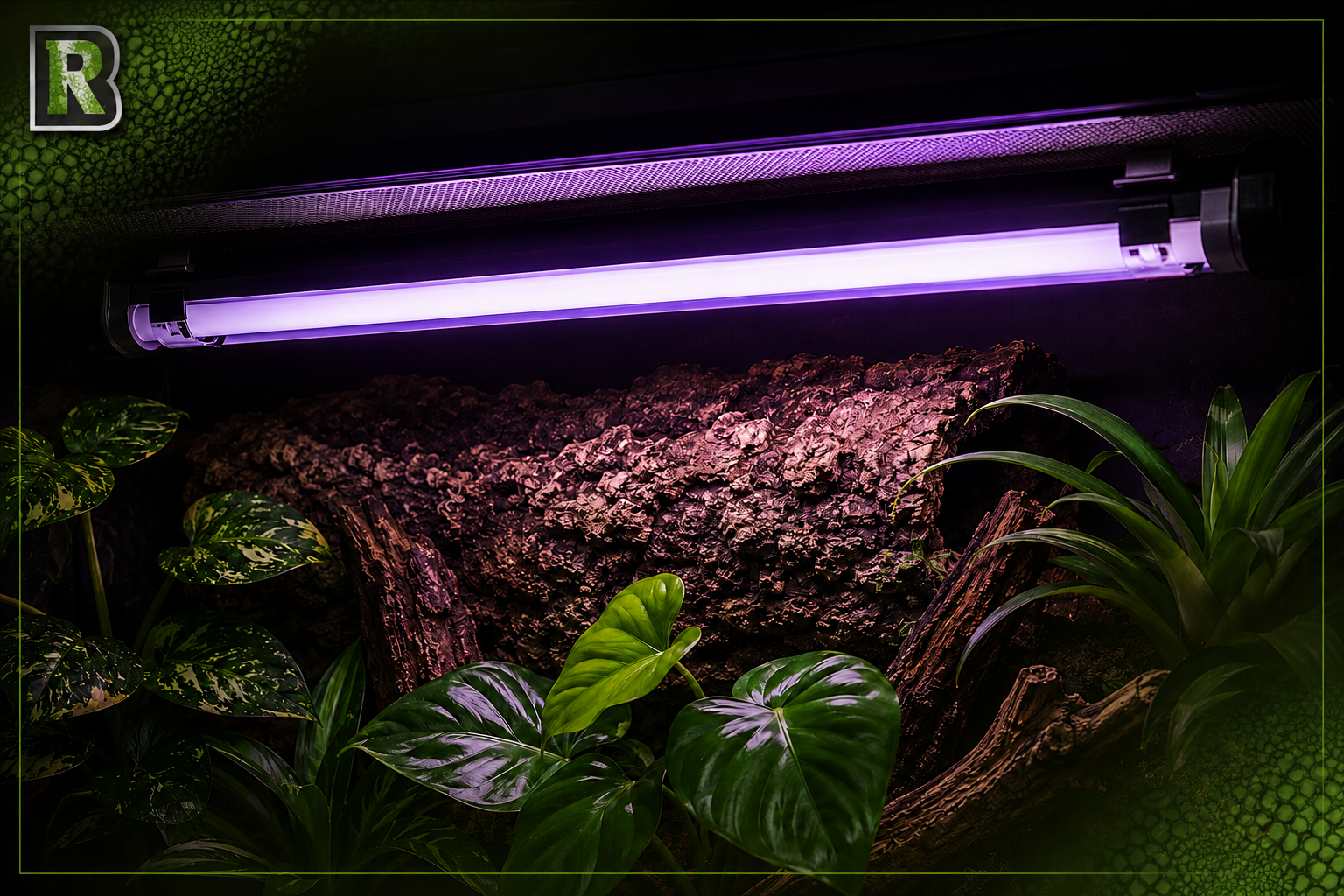
Walk into any reptile keeper’s home and you will almost certainly see a UV lamp running above at least one enclosure. Ask a newer keeper why it is there and you might get a vague answer about it being “good for them.” Ask an experienced keeper and you will get a much more detailed response — because UVB lighting is one of the most important and most misunderstood topics in reptile husbandry.
This guide explains what UVB is, why your reptile needs it, what happens when they do not get it, and how to set up an effective UVB system in your enclosure.
What Is UVB?
Ultraviolet B radiation is a component of natural sunlight. In the wild, reptiles bask in sunlight that contains UVA, UVB, and visible light simultaneously. UVB specifically triggers a process in the skin that produces Vitamin D3 — a compound that is absolutely essential for calcium absorption.
Without Vitamin D3, calcium cannot be properly absorbed from food regardless of how well you dust your feeders. Without calcium, bones weaken, muscles fail, and a condition called Metabolic Bone Disease develops — one of the most common and most preventable causes of suffering and death in captive reptiles.
Which Reptiles Need UVB?
All diurnal reptiles — those active during daylight hours — require UVB. This includes bearded dragons, chameleons, water dragons, uromastyx, blue-tongued skinks, and most monitor species. These animals evolved to spend hours each day exposed to direct sunlight and their biology depends on it.
Crepuscular and nocturnal species like leopard geckos and ball pythons have lower UVB requirements but still benefit from low-level exposure. Current research increasingly supports providing at least some UVB even to traditionally “UVB-optional” species.
The Ferguson Zone System
Not all reptiles need the same intensity of UVB. The Ferguson Zone system, developed by Dr Gary Ferguson, categorises reptiles into four zones based on their natural sun exposure habits. Zone 1 species spend most of their time in shade and require low UVB. Zone 4 species are open-country baskers that need intense, direct UVB exposure.
Matching your UVB lamp to your species’ Ferguson Zone is the most accurate way to provide appropriate UV exposure without risking over-supplementation.
Choosing the Right UVB Lamp
UVB lamps come in two main formats — compact spiral bulbs and linear T5 or T8 tubes. For most setups, a T5 HO linear tube is the preferred choice. T5 tubes provide a wider, more even spread of UVB across the enclosure and maintain their output more consistently over time compared to compact bulbs.
The percentage rating on a UVB lamp indicates its output intensity. A 6% or 10% lamp suits most commonly kept species. High-output 12% lamps are designed for open-country baskers with very high UVB requirements.
UVB Lamp Placement and Distance
UVB output drops sharply with distance. The effective UVB zone of most lamps sits between 20cm and 50cm from the bulb surface, depending on the lamp type and whether a mesh lid is present. Mesh reduces UVB transmission by 30–50%, so factor this in when positioning your lamp.
Place your UVB lamp so that your basking spot falls within the effective UVB zone. Your animal should be able to receive both heat and UVB simultaneously while basking — just as it would in nature.
Replace Your Bulbs Regularly
UVB output degrades over time even when a bulb still appears to be producing visible light. Most UVB lamps should be replaced every 6–12 months depending on the brand and usage hours. Running an expired UVB lamp gives your animal the visible light without the UVB — which means they appear to be getting UV exposure while actually receiving none.
Final Thoughts
UVB lighting is not an optional upgrade. For diurnal reptile species it is a fundamental husbandry requirement. Investing in a quality T5 UVB setup and replacing bulbs on schedule is one of the simplest and most impactful things you can do for your reptile’s long-term health.
Reptile Basics stocks UVB lamps and complete light fixtures suitable for a wide range of species. Browse our Heating and Lighting range to find the right UVB solution for your enclosure.